

Carbon credits are created by means of specific standards and methods which set out how greenhouse gas (GHG) emission reductions or removals are to be measured, monitored and verified.
Because the Verra Verified Carbon Standard (VCS) Program employs different methodologies for the various kinds of carbon projects, choosing the right methodology is one of the very first and most important steps when developing a carbon project.
What Is a Verra Methodology?
A Verra methodology provides the technical framework for determining:
- Project eligibility
- Baseline scenario
- Additionality
- Project boundaries
- Emission reductions or carbon removals
- Monitoring requirements
- Leakage and uncertainty
- Data and verification requirements
In simple terms, the methodology establishes how a project’s carbon benefit will be calculated and proven.
Common Project Types and Verra Methodologies
| Project Type | Example Methodology | Main Carbon Benefit |
| Solar & Renewable Energy | VMR0017 | Avoided emissions |
| Afforestation & Reforestation | VM0047 | Carbon removal |
| Improved Forest Management | VM0045 | Carbon removal |
| Avoided Deforestation | VM0048 | Avoided emissions |
| Agriculture | VM0042 | Emission reductions & removals |
| Biochar | VM0044 | Carbon removal |
| Clean Cookstoves | VM0050 | Emission reductions |
| Landfill & Waste | Applicable VCS/CDM methodologies | Methane reduction |
| Biomass Energy | Applicable VCS/CDM methodologies | Avoided emissions |
| Energy Efficiency | Project-specific applicable methodology | Emission reductions |
The exact methodology must always be confirmed against Verra’s latest methodology database and applicability requirements.
How to Select the Right Verra Methodology? (Verra VCS Project Development Process )
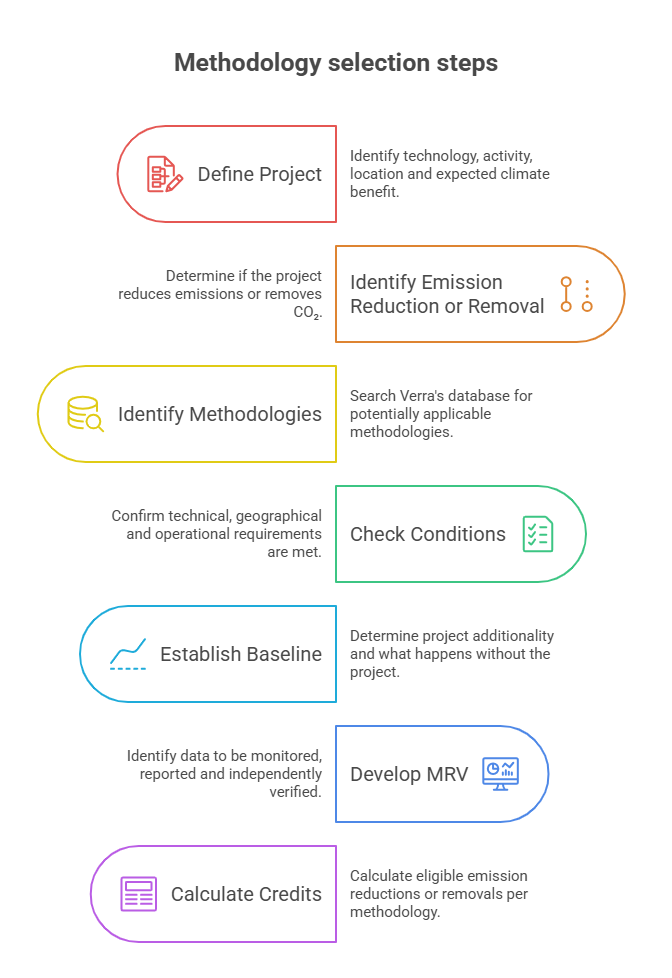
Methodology selection should generally follow these steps:
1. Define the Project –
Clearly identify the technology, activity, location and expected climate benefit.
2. Identify the Emission Reduction or Removal –
Determine whether the project reduces emissions or removes and stores CO₂.
3. Identify Applicable Methodologies –
Search Verra’s current methodology database for potentially applicable methodologies.
4. Check Applicability Conditions –
Confirm that the project meets all technical, geographical and operational requirements.
5. Establish Baseline & Additionality –
Determine what would happen without the project and whether the project qualifies as additional under the applicable rules.
6. Develop MRV System –
Identify the data that must be monitored, reported and independently verified.
7. Calculate Carbon Credits –
Calculate eligible emission reductions or removals according to the methodology.
What If No Methodology Fits?
It doesn’t follow that there is an established methodology that applies to every new technology or project type.
The project developer could then investigate the creation of a new methodology or the amendment of an existing one by using Verra’s methodology-development process.
This is especially relevant to emerging technologies and innovative carbon-removal projects.
Why Methodology Selection Matters?
Choosing the right methodology at the beginning can help determine:
- Whether the project is eligible
- How many carbon credits it may generate
- What data needs to be collected
- What monitoring infrastructure is required
- What evidence will be needed for verification
- Whether the project is commercially viable
Therefore, carbon-credit development should begin with methodology and eligibility assessment—not simply with a carbon-credit calculation.
Disclaimer: Verra methodologies and program requirements are periodically updated. Always refer to the latest official Verra documentation before developing or registering a carbon project.
Summary:
A carbon project is only as strong as the methodology and data supporting its claimed climate impact. Whether the project involves renewable energy, agriculture, forestry, waste management, biochar or energy efficiency, identifying the right methodology at the beginning provides the foundation for credible carbon quantification and verification.
For businesses exploring carbon-credit opportunities, the first practical step is to understand what emissions the project can reduce or remove, what data is available, and which methodology can appropriately quantify the impact.
How Revive Sustainable Can Help:
At Revive Sustainable, we help businesses assess their projects for carbon-credit opportunities and identify suitable carbon-market pathways.
Our services include:
- GHG Emission Calculation: Scope 1 & Scope 2 emission assessment using our in-house carbon calculator and relevant emission factors.
- Carbon Reduction Assessment: Identifying major emission sources and potential areas for reduction.
- Carbon Market Advisory: Understanding suitable carbon-market pathways such as India’s CCTS, Verra, Gold Standard.
- Carbon Credit Development: Supporting project assessment, methodology selection, carbon-credit potential and the overall crediting process.
Measure your emissions. Identify your opportunities. Choose the right carbon pathway.
